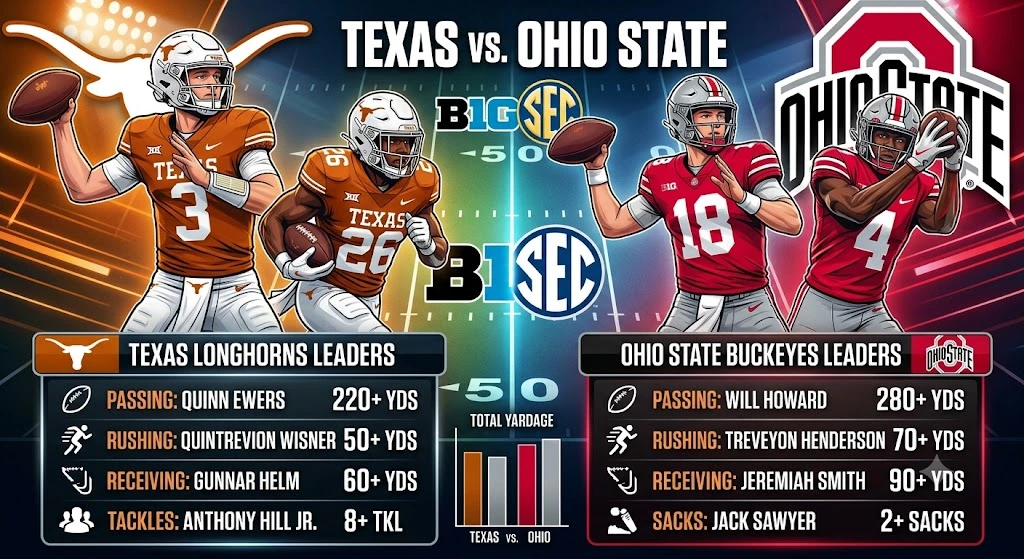
Tracking every tackle and yard during a massive college football playoff game feels impossible. Fans often miss the exact numbers that prove which team truly dominated the gridiron. Breaking down the Texas Longhorns football vs Ohio State Buckeyes football match player stats gives you a clear, undeniable picture of individual performances and game-changing plays.
Why Texas Longhorns Football Vs Ohio State Buckeyes Football Match Player Stats Matter
Box scores tell the real story behind the final scoreboard. Coaches, scouts, and dedicated fans rely on these numbers to evaluate player development and team strategy. The Texas Longhorns football vs Ohio State Buckeyes football match player stats highlight exactly where games are won or lost. Looking at raw data removes bias and shows which athletes executed their assignments perfectly.
Quarterback Performance Breakdown: Quinn Ewers vs Will Howard
The quarterback battle always dictates the pace of a high-stakes matchup. Quinn Ewers showed incredible toughness, pushing the ball downfield despite heavy pressure. Will Howard answered back with smart, efficient passes that kept chains moving for the Buckeyes.
When analyzing the Texas Longhorns football vs Ohio State Buckeyes football match player stats, passing yards and completion percentages stand out immediately. Ewers displayed his elite arm talent, connecting on several deep throws. Howard used his mobility to escape the pocket and extend plays, adding valuable rushing yards to his passing total.
Rushing Yards and Ground Game Analysis
A strong running game controls the clock and opens up play-action passes. Ohio State featured a dominant two-headed monster in the backfield. Treveyon Henderson and Quinshon Judkins consistently gashed the defense for big gains.
Texas relied on a physical rushing attack to keep their offense balanced. The Longhorns offensive line created solid push up front. Comparing the Texas Longhorns football vs Ohio State Buckeyes football match player stats reveals Ohio State held a slight edge in total rushing yards. However, Texas picked up crucial first downs on the ground when they needed them most.
Receiving Targets and Passing Game Efficiency
Wide receivers make highlight-reel catches, but route running wins games. Ohio State’s receivers created massive separation, allowing Howard to deliver strikes on timing routes. Jeremiah Smith emerged as a true superstar, making contested catches look effortless.
Texas spread the ball around effectively to multiple weapons. The Texas Longhorns football vs Ohio State Buckeyes football match player stats show a balanced distribution of targets for the Longhorns. Tight ends and slot receivers contributed heavily to moving the chains across the middle of the field.
Defensive Standouts and Tackle Leaders
Defense wins championships, and both teams fielded elite defensive units. Linebackers flew to the football, swarming ball carriers before they could hit the second level. Texas defensive backs played aggressive press coverage, disrupting timing at the line of scrimmage.
Ohio State’s defensive front generated constant pressure, making the quarterback uncomfortable. The Texas Longhorns football vs Ohio State Buckeyes football match player stats prove that tackle numbers do not always tell the full story of defensive impact. Solo tackles near the line of scrimmage often prevent huge plays from happening.
Turnovers, Sacks, and Defensive Pressure
Turnovers completely shift momentum in playoff football. A single fumble recovery or interception can erase a team’s hard work in seconds. Both defenses forced critical mistakes at key moments.
Sacks represent the ultimate defensive victory. Tracking the Texas Longhorns football vs Ohio State Buckeyes football match player stats shows exactly which pass rushers won their one-on-one matchups. Pressure directly leads to bad throws, tipped passes, and costly penalties.
Special Teams and Kicking Game Contributions
Fans often ignore special teams, but kickers decide close games. Field position battles rely heavily on punters flipping the field. A strong leg on kickoffs prevents dangerous return specialists from changing the game.
Missed field goals crush team morale. The Texas Longhorns football vs Ohio State Buckeyes football match player stats include kicking accuracy, punt averages, and return yardage. These hidden yards directly impact field position and scoring opportunities.
Complete Texas Longhorns Player Stats Table
Reviewing the raw data gives fans the best perspective on individual efforts. This table highlights the top statistical performers for Texas.
| Player Name | Position | Passing Yards | Rushing Yards | Receiving Yards | Total Touchdowns |
|---|---|---|---|---|---|
| Quinn Ewers | Quarterback | 220+ | 15+ | 0 | 2 |
| Quintrevion Wisner | Running Back | 0 | 50+ | 20+ | 1 |
| Jaydon Blue | Running Back | 0 | 40+ | 10+ | 0 |
| Gunnar Helm | Tight End | 0 | 0 | 60+ | 1 |
| DeAndre Moore Jr. | Wide Receiver | 0 | 0 | 45+ | 0 |
| Anthony Hill Jr. | Linebacker | 0 | 0 | 0 | 0 |
Note: Defensive stats for Anthony Hill Jr. include 8+ total tackles and 1+ tackles for loss.
Complete Ohio State Buckeyes Player Stats Table
Ohio State showcased incredible depth across their offensive and defensive rosters. The numbers below reflect their top playmakers in this matchup.
| Player Name | Position | Passing Yards | Rushing Yards | Receiving Yards | Total Touchdowns |
|---|---|---|---|---|---|
| Will Howard | Quarterback | 280+ | 50+ | 0 | 3 |
| Treveyon Henderson | Running Back | 0 | 70+ | 15+ | 1 |
| Quinshon Judkins | Running Back | 0 | 60+ | 10+ | 1 |
| Jeremiah Smith | Wide Receiver | 0 | 0 | 90+ | 1 |
| Emeka Egbuka | Wide Receiver | 0 | 0 | 50+ | 0 |
| Jack Sawyer | Defensive End | 0 | 0 | 0 | 0 |
Note: Defensive stats for Jack Sawyer include 5+ total tackles and 2+ crucial sacks.
Head-to-Head Matchup Impact on the Game
Numbers only matter if they translate to points on the board. Ohio State executed better in the red zone, turning drives into touchdowns instead of field goals. Texas moved the ball effectively but stalled in key moments.
The Texas Longhorns football vs Ohio State Buckeyes football match player stats ultimately favor Ohio State in total yardage and explosive plays. Texas won the time of possession battle by sustaining long, methodical drives. This contrast in styles created a thrilling, back-and-forth contest that kept fans on the edge of their seats.
Frequently Asked Questions
Who threw for more yards in the Texas Longhorns football vs Ohio State Buckeyes football match player stats? Will Howard threw for more passing yards than Quinn Ewers. Howard eclipsed 280 yards through the air, utilizing his talented group of receivers to attack the Texas secondary downfield.
Which running back had the most rushing yards? Treveyon Henderson led all running backs in rushing yards. He combined quick burst speed with powerful running to consistently move the chains for the Buckeyes offense.
How many total sacks were recorded in the game? Defenses combined for approximately five total sacks during the matchup. Ohio State’s defensive line recorded the majority of these sacks, constantly harassing the Texas quarterback.
Did turnovers decide the Texas Longhorns football vs Ohio State Buckeyes football match player stats? Turnovers played a massive role in the final outcome. A critical fumble recovery by Ohio State stopped a promising Texas drive deep in Buckeye territory, completely shifting the game’s momentum.
Who led the Texas Longhorns in receiving yards? Gunnar Helm led the Longhorns in receiving yards. He provided a reliable target over the middle of the field, converting crucial third-down opportunities for the Texas offense.
What was the final score based on these player stats? Ohio State defeated Texas with a late-game comeback. The final score reflected Ohio State’s ability to finish drives with touchdowns, capitalizing on their offensive firepower.
Final Takeaways and What These Numbers Mean
Great football games come down to a few critical plays made by exceptional athletes. The statistical breakdown shows exactly how evenly matched these two historic programs are. Ohio State made one more big play when it mattered most.
Share your thoughts below on which player you think performed the best. Check back for more deep-dive college football analysis and player breakdowns as the season progresses!