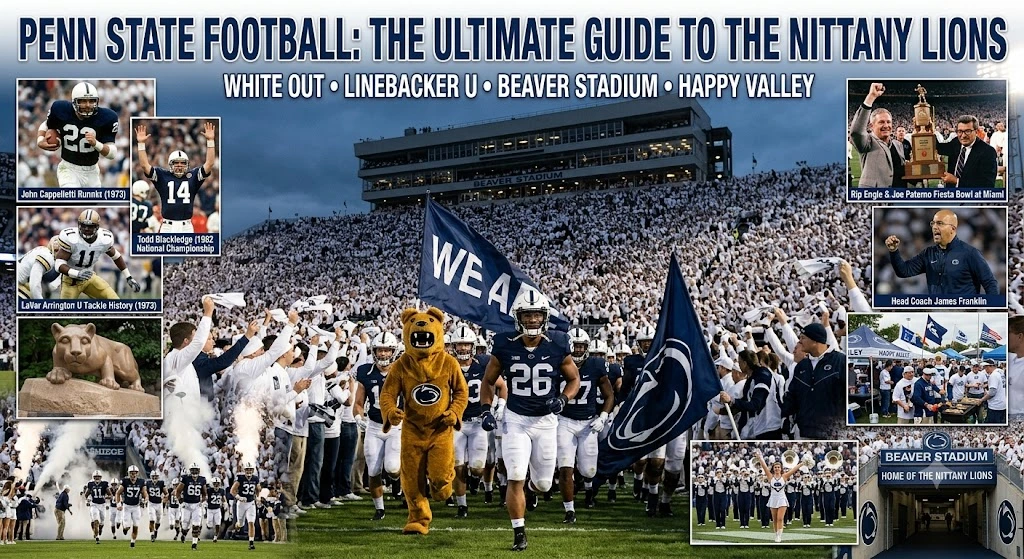
Finding accurate, deep information about Penn State Football often feels frustrating. You sift through scattered stats and biased opinions, which ruins your appreciation for this historic program. This comprehensive guide delivers everything you need to know about the Nittany Lions, from legendary coaches to iconic traditions, giving you clear, expert-level insight immediately.
Penn State Football Program Biography
| Category | Details |
|---|---|
| Program Founded | 1887 |
| Location | University Park, Pennsylvania |
| Stadium | Beaver Stadium (Capacity: 106,572) |
| Stadium Nickname | Happy Valley |
| Team Nickname | Nittany Lions |
| Team Colors | Navy Blue and White |
| Conference | Big Ten (Joined 1993) |
| Claimed National Titles | 1982, 1986 |
| All-Time Record | 900+ Wins |
| Mascot | Nittany Lion |
| Fight Song | “Fight On, State” |
| Official Website | GoPSUSports.com |
What is the History of Penn State Football?
The story of Penn State Football starts back in 1887, making it one of the oldest college football programs in the nation. The team played its first game against Lewisburg (now Bucknell) and won by a score of 54-0. Early on, the program established a culture of tough, physical play that still defines the team today.
For decades, the program operated as an independent, scheduling tough opponents nationwide without a conference affiliation. This independent status allowed the Nittany Lions to build a national brand. They traveled coast to coast, proving their worth against powerhouse programs from the SEC, Big 8, and Pac-10.
The program experienced its first major period of sustained success under coach Rip Engle during the 1940s and 1950s. Engle set the foundation, but his successor took the program to unimaginable heights. The history of this program is a story of resilience, grit, and an unwavering commitment to excellence on the gridiron.
Who Coaches the Nittany Lions Today?
James Franklin currently leads the Penn State Football program as head coach. He took the helm in 2014 after a highly successful stint at Vanderbilt. Franklin brought immediate energy to Happy Valley, stabilizing the program during a turbulent era.
Under his leadership, the team has won a Big Ten Championship (2016) and consistently competed for New Year’s Six bowl games. Franklin emphasizes a culture of “1-0” each week, focusing entirely on the next opponent rather than outside noise. His recruiting prowess keeps the roster loaded with elite talent year after year.
Coach Franklin holds a winning record at the university and remains focused on bringing a national championship back to State College. His offensive and defensive coordinators execute his vision, creating a disciplined and explosive brand of football.
Why is Beaver Stadium So Intimidating?
Beaver Stadium stands as the second-largest stadium in the Western Hemisphere. With a seating capacity of 106,572, the sheer volume of fans creates an overwhelming environment for visiting teams. The structure towers over the Happy Valley landscape, making it a fortress for the home team.
The noise level inside the bowl reaches deafening heights, especially during prime-time matchups. Opposing quarterbacks frequently struggle to communicate play calls at the line of scrimmage. The stadium design traps sound inside, giving the Nittany Lions a massive home-field advantage.
Fans pack the stadium hours before kickoff, turning the surrounding fields into a sea of tailgates. The energy flows from the parking lots right into the stands. Visiting teams often speak about the physical vibration of the stands when 100,000 fans jump in unison.
How Many National Championships Has Penn State Won?
Penn State Football claims two national championships at the highest level of college football. The program won its first title in 1982, led by legendary quarterback Todd Blackledge and tight end Mickey Shuler. That team defeated top-ranked Georgia in the Sugar Bowl to cap off a perfect season.
The second championship arrived in 1986. That squad possessed one of the most ferocious defenses in college football history. They physically dominated opponents all season long. The climax came in the Fiesta Bowl, where they stopped the top-ranked Miami Hurricanes in a hard-fought 14-10 victory.
Beyond the claimed titles, the program finished as the consensus number-two team an astonishing five times. The Nittany Lions also boast several unbeaten, untied seasons where they did not capture the final number-one ranking due to the polling system of those eras. The NCAA officially recognizes the program for its elite historical success.
What Makes the Penn State White Out Special?
The Penn State White Out stands as the greatest tradition in college sports. Once a year, the athletic department designates a massive home game as the White Out. Over 100,000 fans dress entirely in white, creating a breathtaking visual spectacle.
ESPN commentators and visiting media frequently call the White Out the best atmosphere in sports. The tradition started in 2004 against Purdue and evolved into a national phenomenon. The combination of the all-white crowd, the night sky, and the roaring noise creates a surreal environment.
Players feed off the electricity of the White Out crowd. The team often plays with elevated intensity during these games. Recruits visiting for White Out games immediately understand the passion of the fanbase, making it a powerful recruiting tool for the coaching staff.
Who Are the Greatest Players in Program History?
The Nittany Lions have produced a stunning list of legendary players. John Cappelletti won the Heisman Trophy in 1973, becoming the only player in program history to earn college football’s highest honor. His emotional acceptance speech remains a defining moment in sports history.
Linebacker U is a nickname earned by the sheer number of dominant linebackers who wore the blue and white. Players like Jack Ham, LaVar Arrington, Paul Posluszny, and Shane Conlan anchored legendary defenses. They struck fear into the hearts of opposing offenses every Saturday.
Recently, running back Saquon Barkley captivated the nation with his electrifying play. Barkley broke countless records and became the number-two overall pick in the NFL Draft. Other modern stars include defensive end Carl Nassib and tight end Kyle Pitts rival, Pat Freiermuth.
How Does Penn State Football Recruit Top Talent?
Recruiting serves as the lifeblood of any elite college football program, and Penn State Football excels in this area. The coaching staff targets the rich talent pools in Pennsylvania, New Jersey, Maryland, and Virginia. They treat the Northeast corridor as their primary territory.
Franklin and his staff prioritize building relationships with high school coaches and families. They look for high-character athletes who fit their strict cultural standards. The program sells its world-class facilities, top-tier academics, and massive alumni network during the recruiting process.
The results speak for themselves. The Nittany Lions consistently sign top-15 recruiting classes according to 247Sports and ESPN. These incoming freshmen provide the depth and star power necessary to compete for Big Ten titles every season.
What Are the Biggest Rivalries for the Nittany Lions?
Rivalry games define college football, and Penn State Football boasts several fierce matchups. The rivalry with Ohio State ranks at the top currently. These two Big Ten East powerhouses consistently battle for conference supremacy and College Football Playoff spots. The games are intense, physical, and often decided in the final minutes.
The Pittsburgh Panthers represent the program’s oldest and most bitter in-state rival. The teams played 100 times before the series paused recently. The “Backyard Brawl” atmosphere always brings out intense emotion from both fanbases, splitting the state of Pennsylvania down the middle.
Michigan also serves as a major conference rival. The matchups against the Wolverines often carry massive implications for the Big Ten East division crown. The physicality in these games matches the intensity of the NFL.
How Has the Program Evolved in the Big Ten?
Penn State Football joined the Big Ten Conference in 1993. This move changed the trajectory of the program forever. After a century as an independent, the team finally had a conference home. The move provided stability and created automatic access to major bowl games.
Early Big Ten success came quickly. The team won the conference title in its second year (1994) behind the explosive offense of Kerry Collins, Ki-Jana Carter, and Bobby Engram. That 1994 squad is widely considered one of the greatest college football teams ever assembled.
Today, the program navigates the brutal Big Ten East division. Playing against Ohio State, Michigan, and Michigan State every year demands peak physical conditioning and elite coaching. The program has adapted by upgrading its strength programs and investing heavily in Name, Image, and Likeness (NIL) opportunities for players.
What Does the Future Hold for Penn State Football?
The future of Penn State Football looks incredibly bright. The program recently approved massive renovations to the Lasch Football Building and Beaver Stadium. These facility upgrades ensure the team stays competitive in the ever-changing landscape of college athletics.
The expansion of the College Football Playoff to 12 teams provides a realistic path to a national championship. The Nittany Lions consistently finish in the top 10-15 range. A 12-team playoff gives them the exact opportunity they need to compete for a title on the field.
Furthermore, the program’s collective NIL group, “We Are,” empowers players to earn significant money while staying in Happy Valley. This financial support keeps veteran players in school rather than transferring or entering the NFL Draft early. The foundation for a national championship run is firmly in place.
How Can Fans Get the Best Game Day Experience?
A trip to Happy Valley requires careful planning to maximize the experience. Fans must arrive early to enjoy the massive tailgating scene. The fields surrounding Beaver Stadium fill up hours before kickoff, offering incredible food, music, and camaraderie.
First-time visitors absolutely must walk through the All-Sports Museum located inside Beaver Stadium. The museum houses the Heisman Trophy, national championship trophies, and historic uniforms. It provides a deep appreciation for the program’s rich heritage.
Finally, fans should listen for the Blue Band as it marches to the stadium. The drumline cadence echoes through the valley, sending chills down your spine. Grab a grilled stickie from the campus bakery, find your seat, and get ready to sing “Fight On, State” with 100,000 of your closest friends.
Frequently Asked Questions About Penn State Football
What is Penn State Football’s all-time record? Short Answer: The program holds an all-time record of over 900 wins. Supporting Content: This incredible win total places the Nittany Lions among the top ten winningest programs in NCAA history. The program has achieved this record over more than 130 seasons of competition. Consistency and tough scheduling are the main reasons for this sustained success.
Why are they called the Nittany Lions? Short Answer: The name comes from Mount Nittany, a local mountain landmark. Supporting Content: According to official university history, the name originated in 1904. A baseball player named Harrison “Joe” Mason heard Princeton boasting about their tiger mascot. Mason instantly invented the Nittany Lion, a fierce mountain lion native to the region, to counter the tiger. The name stuck forever.
How many Heisman winners does Penn State have? Short Answer: The program has exactly one Heisman Trophy winner. Supporting Content: Running back John Cappelletti won the prestigious award in 1973. He rushed for 1,522 yards and 17 touchdowns that season. Several other Nittany Lions, like Chuck Fusina and Saquon Barkley, finished as finalists, but Cappelletti remains the sole winner.
What is the capacity of Beaver Stadium? Short Answer: Beaver Stadium seats 106,572 fans. Supporting Content: This makes it the second-largest stadium in the Western Hemisphere, trailing only Michigan Stadium. The stadium expanded several times over the decades to accommodate the massive fan demand. Standing room only crowds occasionally push the actual attendance even higher.
When did Penn State join the Big Ten? Short Answer: The program officially joined the Big Ten in 1993. Supporting Content: After spending over a century as an independent, the university sought conference stability. The Big Ten invited the school, adding a major eastern market to its footprint. The move immediately created new rivalries and changed the national scheduling landscape.
Who is the all-time leading rusher? Short Answer: Evan Royster holds the all-time rushing record. Supporting Content: Royster amassed 3,932 rushing yards during his career from 2007 to 2010. He surpassed Curt Warner’s long-standing record. Saquon Barkley came close but left early for the NFL Draft, keeping Royster at the top of the record books.
The legacy of Penn State Football is built on toughness, tradition, and an unbreakable community. From the echoing roars of the White Out to the legendary linebackers, this program represents the very best of the sport. Whether you are a lifelong fan or a newcomer, the story of the Nittany Lions offers endless inspiration. Share your favorite Penn State memory in the comments below, and tell us which game you are most excited for this upcoming season!