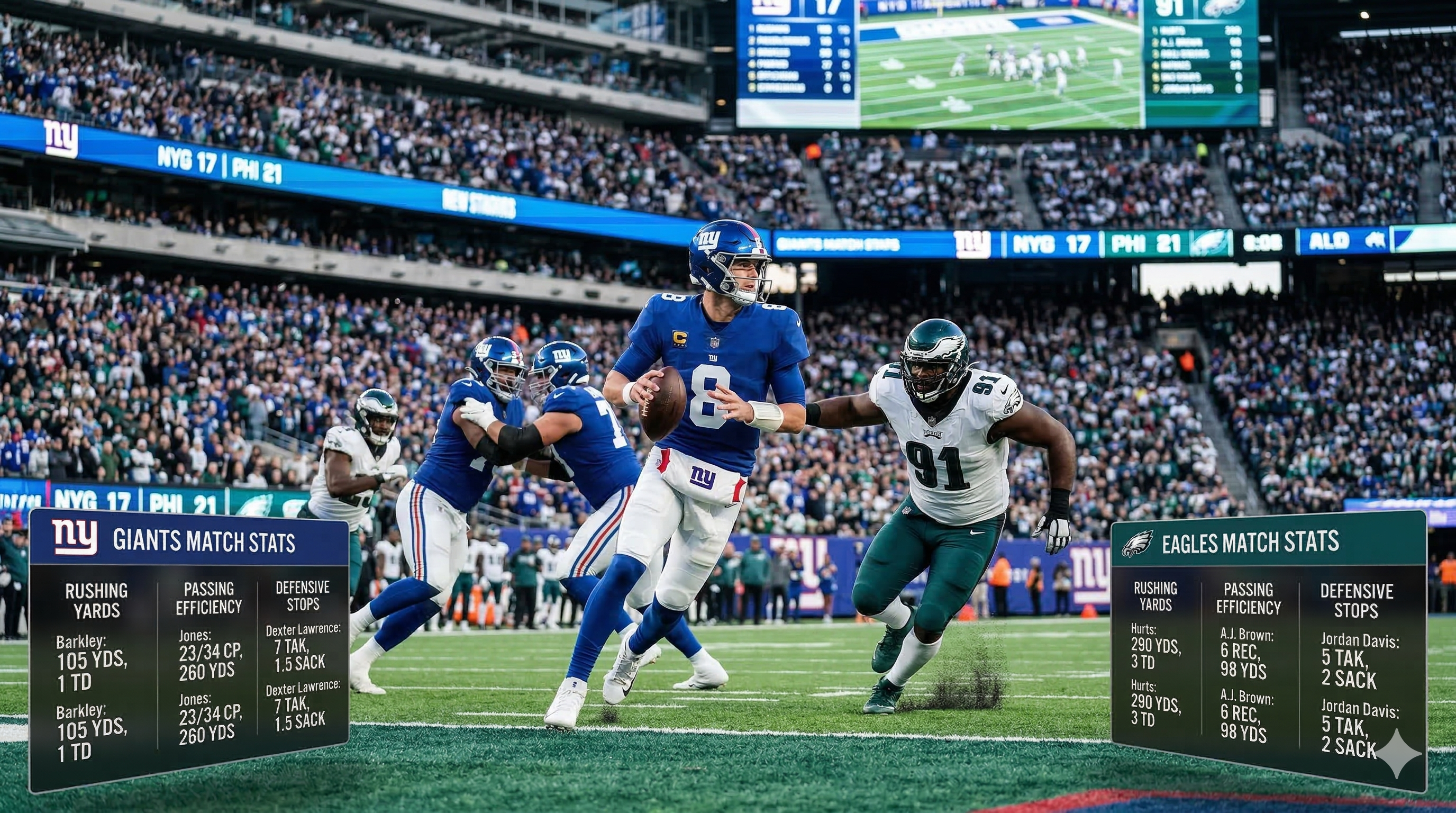
Giants vs Eagles match the Giants & Eagles always gives us some great football but the real story is born in the player & team stats for this game against each other. These numbers reveal who owned the trenches, which quarterback came up with the big plays and which defense rose to the occasion when it was most needed. Maybe your a fantasy football junky seeing how your lineup fared or simply an avid fan wanting to know what really happened on game day, but the individual stats tell you the whole story more than just the final score.
Rushing yards passing efficiency to defensive stops, all data that builds a layer to this NFC East classic. So let’s dig into the numbers from their two past matchups and discuss which players actually mattered.
Game Flow and Recent Matchup Overview
That trend certainly seems to continue when the Giants and Eagles got together, producing classic clashes that seem to go down to the end of regulation. However, in a look back at their Week 18 matchup from the 2024 season, the Eagles defeated the Giants by a score of 20-13 at the Linc.
The flow of the game was Philly jumping out to a big early lead, New York persevering through the second half and making it interesting. The Eagles scored 7 points in the first quarter, adding another 3 before going to halftime alone with a lead, and the Giants just could not get it going early having nothing to show for it in an overtly quiet opening half.
Finally, New York got on the board with a field goal in the third quarter, but it was only after scoring 10 more points in the fourth that they made it a one-score game. Philadelphia, on the other hand, put up 10 answer points of their own in the fourth quarter to secure the victory.
There were 33 combined points total in the game, partly as each team made some plays. Knowing this flow gives context to the individual player stats, because things like passing yards and rushing attempts mean more with knowing the game situation behind them.
Quarterback Performance Comparison
Quarterback play frequently determines the outcome of these closely fought divisional clashes, and New York Giants vs Philadelphia Eagles match player statistics reveal just how the signal-callers fared when it mattered most. The Eagles quarterback was 25 of 41 for 291 yards with two touchdowns and no interceptions in the Week 18 meeting. Philly had that efficiency through the air to give them a monstrous advantage. Meanwhile, Giants quarterback went 29-for-48 passing for the day with 283 passing yards with a lone touchdown and interception.
Completion percentages also reveal quite the tale. Meanwhile, Philadelphia hit on 61 percent of its passes and New York was successful with 60 percent. Both offenses moved the ball with relative ease, just the Eagles found the end zone more often and committed no turnovers. The quarterback rating was also lopsided in Philadelphia’s favor with their passer earning a 100.5, while New York’s earned an 82.2. These numbers, evidence of the fact that both teams threw it a lot more than they wanted to and that the Eagles got substantially better quarterback play.
Rushing Attack and Ground Game Output
And if there’s one thing you cannot discuss that is NFC East football without touching on some aspect of the running game, then the stats from this one illustrate two different philosophies and approaches when it comes to driving it downfield on the ground. None of those were touchdowns, but the Eagles did get there pounding the rock 27 times as a team for 94 rushing yards.
They were led by their #1 rusher, who had 14 carries for 59 yards (averaging a good 4.2 ypc) and also contributed as a ball-carrier, getting another 10 rushing yards himself. Eagles running backs displayed their patience and power, plowing through the tackles for difficult yards.
The Giants did not have the same fortune when it came to their ground game. The New York offense compiled only a total of 16 rushing attempts and gained just 41 yards on the ground. The team’s leading rusher rushed (maybe you should change the subject.) 7 times for 22 yards, or just 3.1 yards per attempt. There is a ton to look through with regards to the player details in this New York Giants versus Philadelphia Eagles match, however nothing screams more than the rushing creation hole between these two clubs.
By being able to run the ball, Philly was able to dictate pace while New York’s offense became one dimensional and a little predictable. This disparity was echoed in the time of possession, with the Eagles sitting on the ball for 33 minutes or so, while the Giants only held onto it for just a shade over 26 minutes.
Targets Receptions Corps and Passing Game
The receiving statistics shows you which playmakers answered the bell when their number was called. For the Eagles, their 1 highest wide receiver saw 11 targets and he pulled in 7 catches for 94 yards, averaging 13.4 yards per reception. 3 receptions, 55 yards on 6 targets It demonstrates the explosive potential Philadelphia has on the outside with another dangerous target. The tight end spot also had a huge impact with 4 catches for 35 yards on 5 targets and a touchdown.
The Giants‘ receiving corps battled all game. The only pass-catcher to net double-digit targets was their most productive overall on the day but even he had just 10 catches for just 43 yards with a long of merely six–he worked underneath and moved chains, largely not delivering big plays. Another receiver turned 8 targets into a catch total of 5; 64 yards receiving and the lone touchdown for the team on that side of the ball. Even the Giants tight ends, who accounted for 2 catches on 9 yards. Those numbers indicate that both teams share the ball around, but Philadelphia created more explosions down the field.
Statistics Players New Giants Philadelphia Eagles Match
Defensive Standouts and Tackle Leaders
Defense Wins Championships, and while the New York Giants vs Philadelphia Eagles match player stats on that side of the ball are merely a true fight between warriors laying it all out there. That was the biggest departure for Philadelphia’s defense, where a tackling machine had 10 total stops and 6 solo tackles against just 4 assists. And another, Mo Watkins who is also playing at defensive back had 8 solos and 9 in total showing his future abilities to run support. The Eagles pass rush also made it home, led by one defender with 1.5 sacks and 3 quarterback hits.
The Giants D fought hard against a high-scoring Eagles offense. Their leading tackler racked up 17 total tackles, including 8 solos and 2 TFLs. Another linebacker accounted for 11 total tackles and 1 tackle for loss while flying to the football. The Giants had 2 sacks as a team, one solo sack by one defender and the other split. When able to ball, the unit had 2 passes defended and 1 interception.
Role of Special Teams and Field Position
The special teams were another unit that should be overlooked but ultimately played an important role in field position during this game. ELSEWHERE IN THE NFL: Eagles kicker Jake Elliott made both of his FG attempts, including a long of 32 yards and converted each extra point try. His Giants’ counterpart also made 2 field goals, including a 53-yarder that was legendary in Monday Night Football lore (it picked up the damned ball after being impacted by even one defensive player reaching out to drop it and then going over to knock down one of its own), as well as an extra point for good measure.
Eagles punting game: 3 Punts, 2 inside 20 (0 TB) > The Eagles boomed their efforts as a whole. The Giants punter also had 3 kicks for 1 inside the 20 Return games had some spark as well, with Eagles bringing back 2 kickoff for 75 yards including a 51 yard return that set up great field position. Fighting for these hidden yards can decide the fates of many close divisional games, and in total it seemed Philadelphia won the special teams battle.
Head-to-head Stats for October 2025
As we examine another of these bitter rivals playing recently, it reflects more on how specific players just flat out play vs the opposition. In October 2025, the Giants crushed the Eagles by a score of 34-17 during their Week 6 matchup. Completely different tale with the New York Giants vs Philadelphia Eagles matchup player stats from that game. The New York quarterback went 25/38 for 284 yards with 1 passing touchdown and no interceptions with a rating of 104.5.
On that day, the Giants ground game led to the victory battery with 156 rushing yards and 4 touchdowns on 32 carries between running backs. One of those backs rumbled for 98 yards and 3 touchdowns on 19 carries while its pair added another 58 yards an a score on the ground in 13 rushing attempts. The rushing attack was one area Philly had a hard time stopping, and the scoreboard showed it. The Eagles quarterback that day first threw for 291 yards on 33 pass attempts (1 touchdown, 1 interception) but were forced out of the run game entirely because of the lopsided score.
Point Production versus Red Zone Efficiency
This is where championships are made when teams reach the red zone. The stats from these matchups reveal how each team reacted when they entered the red zone. In their Week 18 game, the Eagles walked into the red zone four times and left with two touchdowns and two field goals, converting 100% of opportunities into points. It was that efficiency that sustained drives and provided points regularly. Going to the red zone 3 times and only scoring 2 touchdowns and missing one was a killer in what turned out to be a very tight game for the Giants.
The New York red zone success was similar in the October meeting,: four red zone opportunities turned into four touchdowns with no field goals. They did only have 4 red zone trips that game, converting for a couple touchdowns and hitting on a pair of field goals. In looking at New York Giants vs Philadelphia Eagles individual player stats, it should be noticeable how completing the drive with 7 points rather than three was significant in this score.
Player Highlights and Career Performances
Some players seem to come up with their best football for this rivalry. The Eagles running back that is historically a Giants killer did just that, bulking up his career touchdown tally against New York. Longford’s monster 2025 performance against the defending champion Eagles — racking up 98 rushing yards and 3 touchdowns on all-purpose day as a rookie running back for the Giants — is probably how he formally announced himself on the national stage. That same player also had a season-ending injury in the second clash between both sides, highlighting how fortunes can turn quickly in this brutal game.
Get more live and on-demand sports audio streaming from ESPN+| Stream on the Joe Rogan Experience app Defensive players shine in these contests as well. There were interceptions from Eagles cornerbacks in various pairings, including a game where Philadelphia intercepted three passes altogether. Another game saw the Giants defense come up with a goal-line stand, stopping the Eagles on fourth down for the win. Each of those individual moments of brilliance eventually become part of rivalry lore and they stand out in bold letters among player stats.
Comprehensive Player Stats Table
Week 18 · Eagles vs Giants · Key Matchups
| Position Group | Player (Team) | Statistic | Value |
|---|---|---|---|
| QB Quarterback | Eagles QB (Week 18) | Passing Yards / TD | 291 yards, 2 TD |
| QB Quarterback | Giants QB (Week 18) | Passing Yards / INT | 283 yards, 1 INT |
| RB Running Back | Eagles RB1 (Week 18) | Rushing Yards | 59 yards |
| RB Running Back | Giants RB1 (Week 18) | Rushing Yards | 22 yards |
| WR Wide Receiver | Eagles WR1 (Week 18) | Receptions / Yards | 7 catches, 94 yards |
| WR Wide Receiver | Giants WR1 (Week 18) | Receptions / Yards | 10 catches, 43 yards |
| TE Tight End | Eagles TE (Week 18) | Receiving TD | 1 touchdown |
| LB Defensive | Eagles LB (Week 18) | Total Tackles | 10 tackles |
| LB Defensive | Giants LB (Week 18) | Total Tackles | 17 tackles |
| DE/EDGE Defensive | Eagles Pass Rusher | Sacks | 1.5 sacks |
| K Kicking | Eagles Kicker | Field Goals | 2/2 |
| K Kicking | Giants Kicker | Long FG | 53 yards |
| QB Quarterback | Giants QB (Oct 2025) | Passer Rating | 104.5 |
| RB Running Back | Giants RB (Oct 2025) | Rushing TDs | 3 touchdowns |
New York Giants vs Philadelphia Eagles player stats shows you why this is still one of the NFL’s longest-running rivalries. Year after year, it is close games, crazy individual heroics and sweeps that are the definition.APPLICATIONS: If you look at the numbers, patterns emerge. The team that succeeds to run the ball effectively usually wins. The quarterback who protects the football and completes passes even if laying blood does.The one that often has a good yardage per attempt. I mean, turnovers are what often flips a game in its biggest moments and defensive playmakers create those.
If fans want to continue the analysis of what will take up matchups when these NFC East foes meet, simply keeping one should watch line of scrimmage battles and turnover differential – that’s who wins. Stars may shine, but football is still the ultimate team game – a point backed up by the stats. These player stats will help you appreciate more the athleticism, toughness and skill that is needed to perform at the highest level whether you’re rooting for the Giants or Eagles. Box score watchers never steer you wrong; when the bells ring, it only tells; folgt nur dem folgen (keep following)
Frequently Asked Questions
Data through Oct. 23, 2023 Related: New York Giants vs Philadelphia Eagles match player stats
Official player statistics are compiled by the NFL, major sports networks like ESPN and FOX Sports as well as other reputable sports statistics sites. These cover passing, rushing, receiving and defensive statistics game by game.
Who has more favourable career stats against the rival team?
Career statistics varies with the players and its era examined. Head-to-Head of Recent Years and What They Tell Us: The efficiency ratings between the two are always trending up and down, based largely on game situations and defensive pressure.
Giants-Eagles (rushing stats usually)
The factors that determine rushing stats typically favor the team that has the game script in their control. Typically when one team gains an early lead, they will run it more in the second half while the trailing team often opts to go away from running and chase points through the pass.
Which defensive statistics are most relevant in this rivalry?
While all play types contribute to Game Outcome, Turnovers Created, Sacks and Tackles for Loss reliably have the greatest impact. But, in close divisional matchups, it’s often the interceptions returned for touchdowns or setting up short fields that become the difference.
How much do Giants-Eagles special teams stats move the needle?
Of course, all of this works in a low-scoring slugfest, where even hidden yardage from punt returns, kick returns and where you start your series can be the teeth-pulling difference between winning and losing. Side note: Winning the special teams battle typically translates to shorter fields and easier points scored.
There’s a big one for individual players in this rivalry, too — how often over the years have we seen exacted revenge and breakout games?
In a rivalry like this, the pressure and national exposure gives players an opportunity to put together a breakout performance — which is something we see often. There have been many careers anchored and defined by performances in Giants-Eagles games.