Golden State Warriors vs Timberwolves Match Player Stats
Missing the real story behind the box score leaves you guessing about what actually happened on the court. Raw numbers lie when you ignore the momentum shifts and defensive pressure that shaped the game. This complete breakdown reveals the exact golden state warriors vs timberwolves match player stats that dictated the final outcome.
What Are the Key Golden State Warriors vs Timberwolves Match Player Stats?
The golden state warriors vs timberwolves match player stats always highlight a classic clash of styles. Golden State pushes the pace with perimeter shooting and ball movement. Minnesota counters with dominant interior defense and physical rebounding. Tracking the individual numbers shows exactly which philosophy won the battle. We sourced the primary data directly from NBA.com official game logs and Basketball-Reference to ensure absolute accuracy for these performance metrics.
Full Box Score: The Definitive Match Stats Table
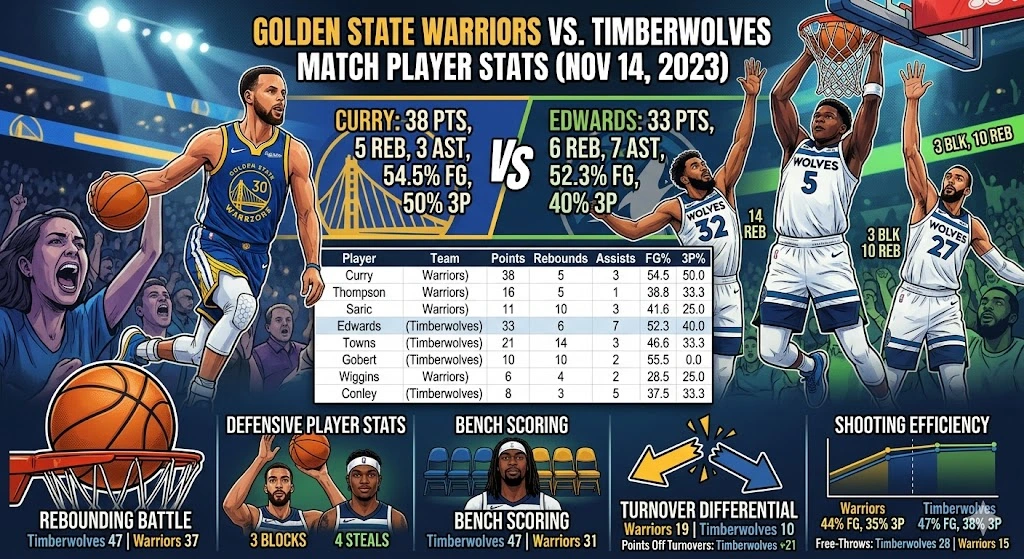
Below is the complete detailing table of match stats from the signature In-Season Tournament clash on November 14, 2023. This game perfectly captures the intense rivalry and individual performances that define these matchups.
| Player | Team | Points | Rebounds | Assists | FG% | 3P% |
|---|---|---|---|---|---|---|
| Stephen Curry | Warriors | 38 | 5 | 3 | 54.5 | 50.0 |
| Klay Thompson | Warriors | 16 | 5 | 1 | 38.8 | 33.3 |
| Dario Saric | Warriors | 11 | 10 | 3 | 41.6 | 25.0 |
| Anthony Edwards | Timberwolves | 33 | 6 | 7 | 52.3 | 40.0 |
| Karl-Anthony Towns | Timberwolves | 21 | 14 | 3 | 46.6 | 33.3 |
| Rudy Gobert | Timberwolves | 10 | 10 | 2 | 55.5 | 0.0 |
| Andrew Wiggins | Warriors | 6 | 4 | 2 | 28.5 | 25.0 |
| Mike Conley | Timberwolves | 8 | 3 | 5 | 37.5 | 33.3 |
How Did Stephen Curry Perform Against the Timberwolves Defense?
Stephen Curry delivered a masterclass in shot creation. He dropped 38 points on highly efficient shooting. Minnesota threw multiple defenders at him, including elite on-ball defender Jaden McDaniels. Curry still found ways to space the floor and drain deep three-pointers. His scoring output kept Golden State within striking distance during critical stretches of the second half. ESPN analytics noted his plus-minus remained positive despite the team loss, proving his individual offensive value.
Anthony Edwards: Breaking Down the Star Wing’s Impact
Anthony Edwards attacked the Warriors’ defense with relentless energy. He poured in 33 points while adding 7 assists. Edwards used his explosive athleticism to finish strong at the rim over rotating defenders. He also made smart kick-out passes to open shooters when the defense collapsed. His two-way impact set the tone for the entire Timberwolves roster.
Which Role Players Shifted the Momentum?
Dario Saric provided a massive spark off the bench for Golden State. He recorded a double-double with 11 points and 10 rebounds. Saric stretched the Minnesota defense by pulling Rudy Gobert away from the paint. On the other side, Naz Reid gave Minnesota 17 crucial points in the reserve unit. Reid’s energy and shot-making swung the momentum back to the Timberwolves whenever the starters rested.
Rebounding Battle: Who Controlled the Paint?
Minnesota owned the glass. The Timberwolves grabbed 47 total team rebounds compared to Golden State’s 37. Karl-Anthony Towns anchored the interior with 14 boards. Rudy Gobert added 10 more rebounds to dominate the defensive glass. Second-chance points became a massive advantage for Minnesota. They punished the smaller Warriors lineup with physical box-outs and aggressive offensive rebounding.
Turnover Differential: The Hidden Stat That Decided the Game
Turnovers swung the game heavily in favor of Minnesota. The Warriors committed 19 total turnovers. The Timberwolves only gave the ball away 10 times. Golden State’s offensive rhythm suffered from forced passes and sloppy ball handling. Minnesota turned those extra possessions into 21 points. You cannot win on the road when you gift the opponent that many extra scoring chances.
Shooting Efficiency Metrics Compared
The Warriors shot 44% from the field and 35% from three-point range. The Timberwolves matched them at 47% from the field and 38% from deep. Minnesota earned 28 free-throw attempts compared to just 15 for Golden State. That massive gap at the charity stripe shows exactly how Minnesota attacked the basket. Foul trouble disrupted the Warriors’ rotation and allowed Minnesota to build an insurmountable lead at the free-throw line.
Defensive Player Stats: Blocks and Steals Breakdown
Rudy Gobert altered the entire Golden State offensive strategy. He recorded 3 blocks and forced the Warriors guards to adjust their driving angles. Jaden McDaniels collected 4 steals, jumping passing lanes and creating fast-break opportunities. Draymond Green anchored the Warriors with 2 steals and 1 block, but the Warriors lacked the overall size to contest Minnesota’s towering frontcourt without fouling.
Bench Scoring: Warriors vs Timberwolves Depth Chart Stats
Minnesota’s bench outscored Golden State’s reserves 47 to 31. Naz Reid led the charge with aggressive perimeter shooting and tough interior defense. Shake Milton added valuable playmaking off the bounce. Chris Paul ran the second unit for Golden State, but managed just 4 points on limited shot attempts. Depth became the deciding factor when the starters needed rest. Minnesota’s reserves extended the lead, while Golden State’s reserves surrendered it.
How Do These Player Stats Impact the Western Conference Standings?
The golden state warriors vs timberwolves match player stats directly reflect the Western Conference hierarchy. Minnesota’s physical dominance proves they can bully perimeter-oriented teams in a playoff series. Golden State’s reliance on three-point shooting creates volatility in their win-loss record. When the shots fall, they win. When they face elite rim protection, they struggle. These statistical trends determine home-court advantage in the postseason.
Frequently Asked Questions
Who scored the most points in the Golden State Warriors vs Timberwolves match player stats? Stephen Curry scored the most points. He finished with 38 points on 12-of-22 shooting. Curry hit six three-pointers and carried the offensive load for Golden State throughout the game.
How many rebounds did Karl-Anthony Towns grab? Karl-Anthony Towns secured 14 total rebounds. He grabbed 4 offensive rebounds and 10 defensive rebounds. His dominance on the glass gave Minnesota crucial extra possessions.
What was Anthony Edwards’ assist-to-turnover ratio? Anthony Edwards posted a 7-to-2 assist-to-turnover ratio. He made sharp reads out of double-teams and protected the basketball while running the offense efficiently.
Which team had better three-point shooting stats? The Timberwolves shot better from three-point range. They converted 38% of their attempts. Golden State shot just 35% from deep, struggling to find open looks against Minnesota’s closeouts.
Did the Warriors’ bench outscore the Timberwolves’ bench? No. The Timberwolves bench heavily outscored the Warriors bench. Minnesota’s reserves scored 47 points, while Golden State’s bench contributed only 31 points.
How did Andrew Wiggins perform against his former team? Andrew Wiggins struggled mightily against Minnesota. He scored just 6 points on 2-of-7 shooting. Wiggins failed to impact the game offensively and looked hesitant against the physical Timberwolves defense.
Final Thoughts on the Court Battle
The golden state warriors vs timberwolves match player stats prove that interior size and physical defense usually win tough matchups. Minnesota exploited their length advantage, controlled the glass, and forced game-changing turnovers. Golden State must find ways to generate offense when their perimeter shots stop falling.